No Hot Water Diagnostic Checker
Follow this step-by-step guide to identify why you have no hot water. Most issues are simple fixes - start here before calling a plumber.
Check the circuit breaker
Is your electric water heater plugged in or tripped?
Check the pilot light (gas heaters)
Is the small flame on your gas heater lit?
Check the thermostat setting
Is the temperature set too low?
Check water supply valves
Is the cold water inlet valve open?
If you turn on the tap and nothing but cold water comes out, it’s frustrating-but not always a sign of a broken water heater. The first thing to check isn’t the heater itself. It’s something much simpler, and chances are, you’ve already got the tools to fix it right now.
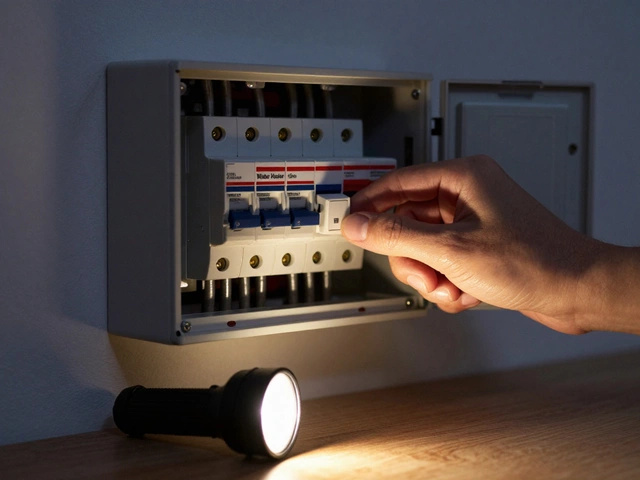
Check the circuit breaker
Most electric water heaters in UK homes run on a dedicated 240V circuit. If the breaker has tripped, the heater won’t heat. It doesn’t make noise. It doesn’t flash a warning light. It just sits there, silent and cold.
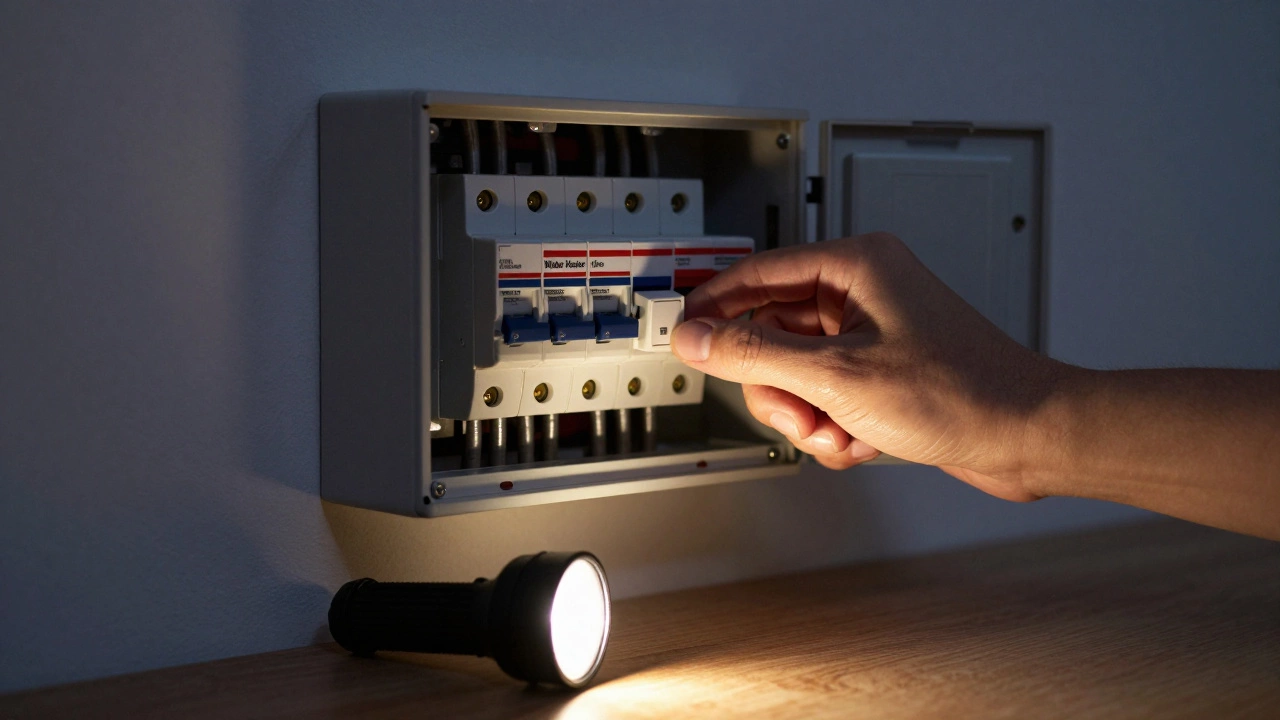
Go to your fuse box. Look for a breaker labeled "Water Heater," "Hot Water," or sometimes just "Heater." It might look normal-flipped up like the others-but that doesn’t mean it’s still on. Tripped breakers often don’t look obviously off. To be sure, flip it fully to the OFF position, then back to ON. You’ll hear a click. If the heater starts working within 30 minutes, that was your problem.
Why does this happen? Overloaded circuits, aging wiring, or a failing heating element can cause small surges. It’s not rare. In fact, over 40% of no-hot-water calls in Bristol during winter are solved by resetting the breaker. Don’t jump to replacing the tank. Start here.
Check the pilot light (for gas heaters)
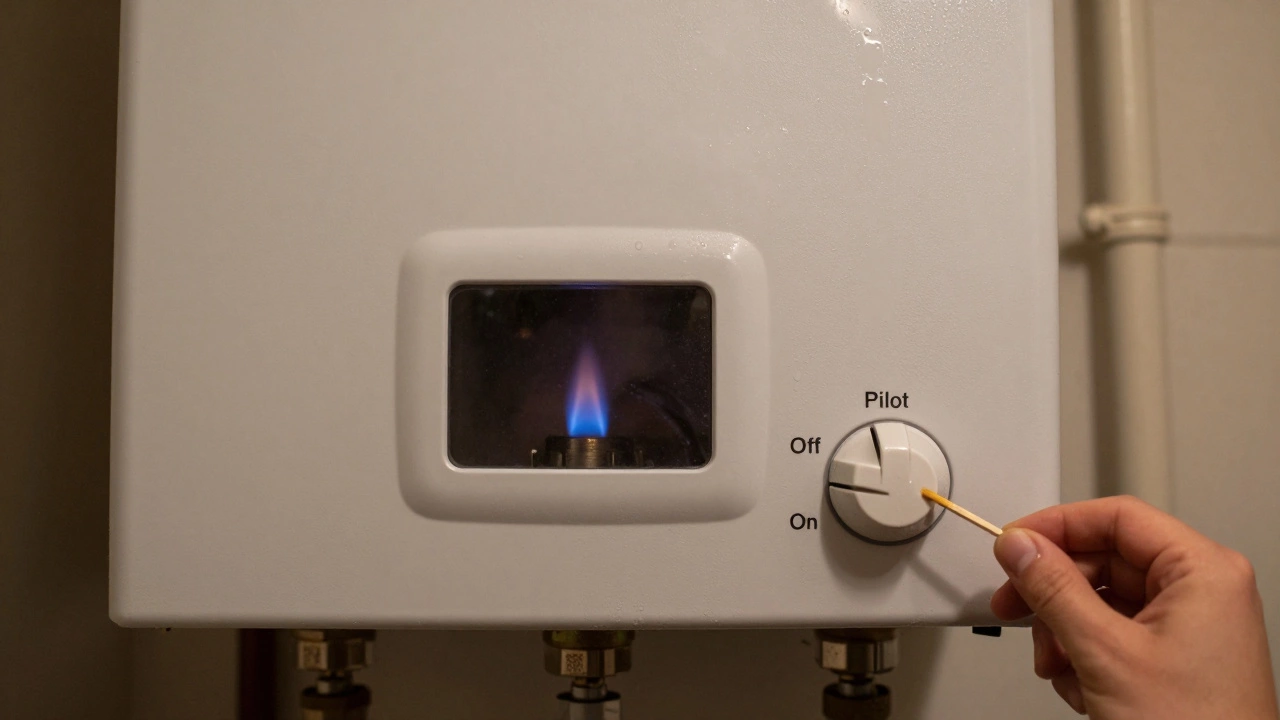
If you’ve got a gas water heater, the first thing to look at is the pilot light. It’s a small, continuous flame that keeps the main burner ready to ignite. If it’s out, no gas flows to the main burner-and no hot water.
Most gas heaters have a viewing window near the bottom. Look for a steady blue flame. If you see nothing, or a weak yellow flicker, the pilot’s out. That doesn’t mean you need a plumber. Many models have a simple reset sequence: turn the gas knob to "Off," wait five minutes, then switch to "Pilot," press and hold the ignition button (or light it manually with a long match), and keep holding for 30 seconds after the flame catches. Then turn the knob to "On."
Why does the pilot go out? Drafts from open windows, a dirty thermocouple, or even a strong gust of wind from an extractor fan can do it. It’s common in older homes with poor ventilation. If the pilot keeps going out after you relight it, the thermocouple might be faulty-but that’s step two.
Check the thermostat setting
It sounds obvious, but people often turn the thermostat down without realizing it. Maybe someone adjusted it to save energy. Maybe it got bumped. Or maybe it’s set to "Vacation" mode.
On electric heaters, the thermostat is usually behind an access panel on the side. It’ll have a dial or digital readout. Make sure it’s set between 50°C and 60°C. Anything below 45°C won’t feel hot under normal tap pressure. On gas heaters, the thermostat is near the bottom, often with a simple dial. Again, check it’s not turned too low.
Here’s a real example: a family in Cheltenham had no hot water for three days. They called a repair service. The technician found the thermostat set to 35°C. The water was warm-just not hot enough to notice. They turned it up. Problem solved. No parts replaced. No cost.
Check for a power or gas supply issue
Is your whole house cold? No lights? No gas hob? Then the issue isn’t your water heater-it’s your supply. Check your gas meter. If the dial isn’t moving, or the emergency shutoff valve is turned perpendicular to the pipe, that’s your culprit.
For electric heaters, check if other high-power appliances (like the oven or dryer) are working. If they’re not, the problem is broader than the heater. Call your utility provider. Don’t waste time trying to fix the heater if the power’s off.
Gas leaks are serious. If you smell rotten eggs, don’t try to relight anything. Open windows, leave the house, and call the National Grid emergency line on 0800 111 999.
Check the pressure relief valve and water supply
Even if the heater is getting power or gas, it won’t produce hot water if it’s not getting cold water in. The tank needs to fill up first. If the inlet valve is closed-or partially blocked-you’ll get cold water from the mains, but no hot water from the tank.
Look for the cold water inlet pipe on top of the heater. There should be a valve where it connects. Make sure it’s fully open. It should be turned counter-clockwise until it stops. If it’s stiff, don’t force it. A corroded valve might need replacing.
Also, check the pressure relief valve on the side of the tank. If it’s leaking or dripping, the tank might not be filling properly. A constant drip means pressure is being released before the tank can heat up. That’s a sign of a faulty valve or excessive pressure. Either way, it needs attention.
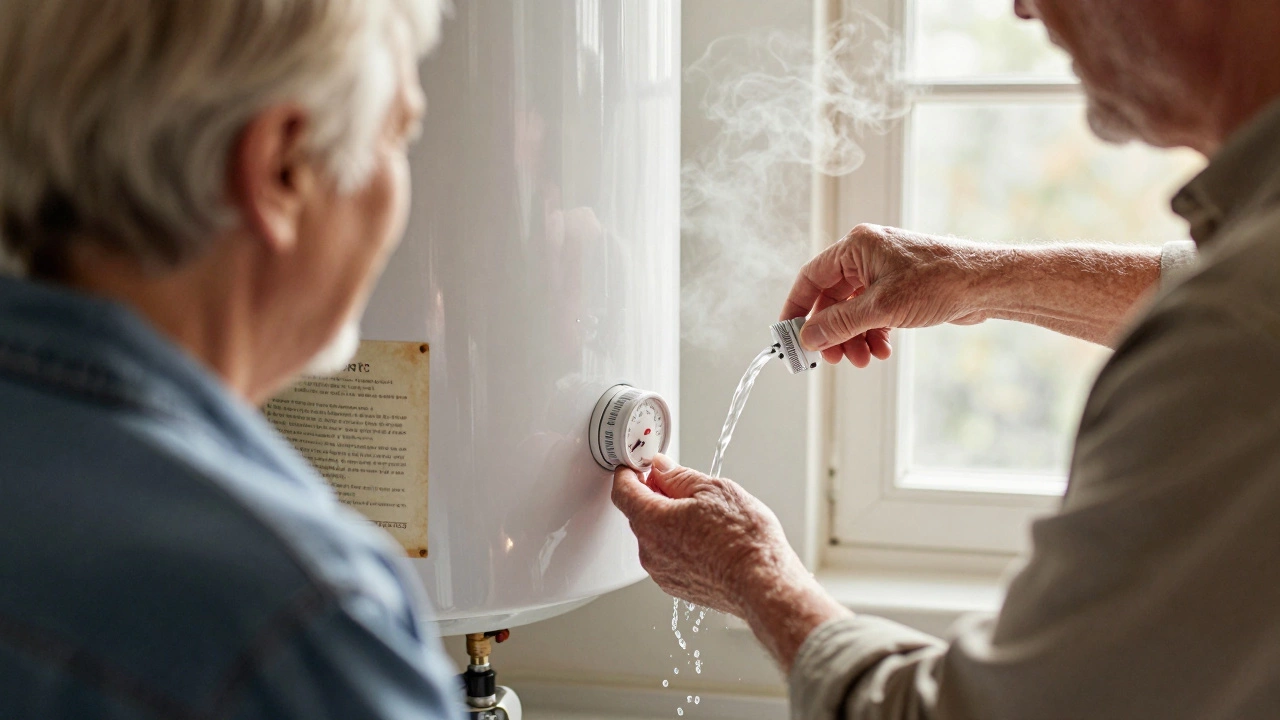
Don’t panic-don’t replace anything yet
Most people rush to replace their water heater after one cold shower. But water heaters last 8-12 years in the UK. If yours is under five years old, it’s likely not broken. The problem is almost always something simple: a tripped breaker, a pilot light out, or a turned-down thermostat.
Replacing a water heater costs £800-£2,500. Resetting a breaker? Free. Relighting a pilot? Free. Turning a knob up? Free. You’ve already got the tools. You just need to check the basics first.
Keep a flashlight and a long lighter in your utility cupboard. If you’ve got a gas heater, keep the manual handy. Most manufacturers include a simple troubleshooting guide on the inside of the access panel. Read it. It’s written for people like you-not technicians.
When to call a professional
If you’ve checked the breaker, the pilot, the thermostat, the valves-and you still have no hot water-it’s time to call someone. But don’t just call the first company you find.
Ask if they test the heating elements with a multimeter. Ask if they check for sediment buildup in the tank. A good technician will drain a litre of water from the drain valve and look for grit. If it’s cloudy or full of particles, sediment is insulating the heater and keeping it from working properly. Flushing the tank can restore performance.
Also, ask about warranty. If your heater is under six years old, it might still be under manufacturer warranty. Some brands cover parts for 10 years. Don’t pay for a new tank if you don’t have to.
Why is there no hot water when the breaker is fine?
If the breaker is on but you still have no hot water, the problem could be a failed heating element, a faulty thermostat, a tripped high-limit switch, or sediment buildup. For gas heaters, it could be a broken thermocouple or a blocked gas valve. These require testing with tools or professional diagnosis.
Can a water heater explode if there’s no hot water?
No, a water heater won’t explode just because there’s no hot water. However, if the pressure relief valve is faulty and the tank is overheating due to a stuck thermostat, pressure can build up. That’s rare, and modern tanks have multiple safety layers. Still, if you smell burning plastic or hear hissing from the tank, turn off the power or gas immediately and call for help.
How long does it take for hot water to come back after resetting the heater?
After resetting a breaker or relighting a pilot, it usually takes 30 to 60 minutes for the water to heat up fully. Electric heaters take longer than gas ones. If after an hour there’s still no hot water, the issue is likely a component failure-not just a reset.
Is it safe to relight a pilot light myself?
Yes, if your heater has a manual ignition and you follow the instructions on the label. Always wait five minutes after turning the gas off to let any gas clear. Use a long lighter or match. Never use a lighter while standing on a ladder. If you smell gas strongly, leave the house and call for help.
Should I turn off the water heater if I’m going away?
Yes, especially in winter. Turn off the power or gas and shut the cold water inlet valve. This prevents leaks and reduces energy use. Some modern heaters have a "Vacation" mode, which keeps the tank at a low temperature. Use that if available.
Fixing no hot water isn’t about fancy tools or expensive parts. It’s about checking the basics before you assume the worst. Start with the breaker. Check the pilot. Verify the thermostat. Look at the valves. You might be just one simple step away from warm water again.